


What Size Chess Pieces Should I Buy for My Chess Board? - ChessBaron Chess Sets
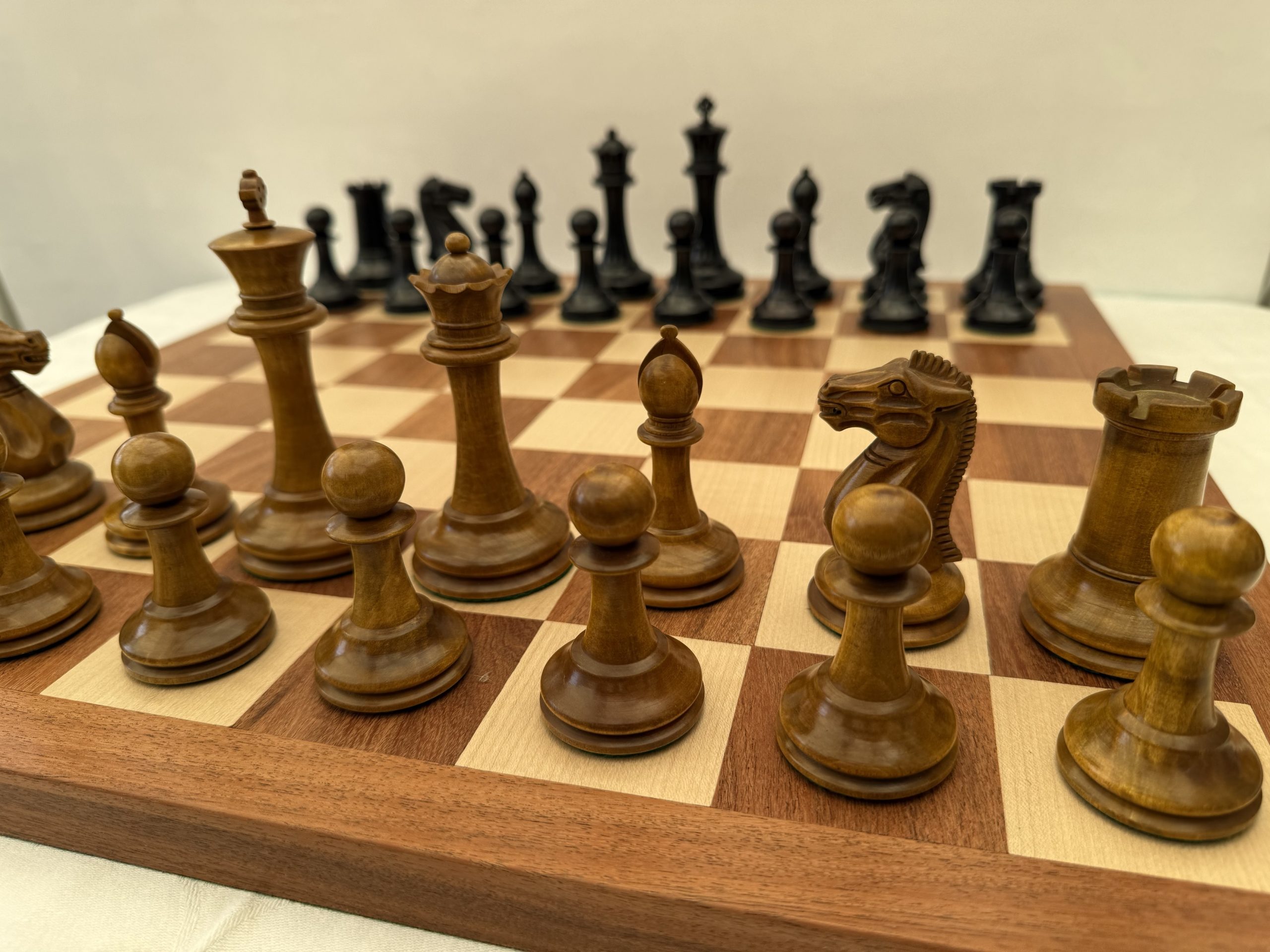
What Size Chess Pieces Should I Buy for My Chess Board?
Matching chess pieces to a board is largely a question of proportion: get the relationship between the king’s base and the board squares right, and the whole set looks and plays better.
Buying chess pieces and a board separately gives you much more freedom to create the set you want. It also introduces one surprisingly common problem: pieces that are simply the wrong size for the board.
A king squeezed into a small square makes the whole position look crowded. Go too far the other way and substantial chess pieces can look strangely lost. Fortunately, you don’t need a complicated formula to avoid either mistake. The most useful measurements are the width of the board squares and the diameter of the king’s base.
Measure the Square, Not Just the Board
If you already own a chess board, measure one individual playing square from edge to edge. The overall dimensions of the board are less useful because borders vary enormously. Two boards of the same external size can therefore have noticeably different playing areas.
As a practical guide, a king’s base occupying somewhere around three-quarters of the square width generally produces comfortable proportions. It leaves enough visible space around the piece while still giving the set a substantial appearance.
King Height Doesn’t Tell the Whole Story
Chess pieces are usually described according to king height, so it is natural to think that this is the measurement that determines the board size. It helps, but it can also mislead.
Consider two genuine examples. The Bronte Ebony Staunton chess pieces have a 4-inch king with a 1.8-inch base. ChessBaron recommends a board with 2-inch squares for this set. That gives the pieces a relatively full, impressive appearance while retaining enough room for practical play.
Move up to the Tuscany Ebony and Antique chess pieces and the king rises to 4.5 inches with a 1.9-inch base. The product is offered alongside several board recommendations, including boards with larger squares. That extra space makes sense for a set of this scale.
Why the Base Diameter Matters So Much
Imagine looking directly down at a chess board. From that angle the height of the pieces becomes almost irrelevant. What determines how crowded the position appears is the amount of each square occupied by the bases.
This becomes particularly noticeable in the centre of the board, where several pieces may occupy neighbouring squares. Generous spacing makes pieces easier to identify and move. A badly overcrowded board can turn a perfectly respectable middlegame into something resembling the queue for the bar at half-time.
There Is Still Room for Personal Taste
There isn’t one mathematically correct combination. Some players like a fairly full board, with substantial pieces dominating the squares. Others prefer more open space around each piece. Decorative and luxury sets can often carry slightly more imposing proportions than a set intended purely for competitive play.
Colour and design affect the impression too. Broad, heavily weighted pieces can appear larger than slender pieces with exactly the same king height. Elaborately carved knights may also benefit from a little more visual space around them.
If You’re Buying the Board Second
If you’ve already chosen the pieces, find the king’s base diameter and use that as your starting point. Check the manufacturer’s recommended boards where available, then decide whether you favour a fuller or more spacious appearance.
If you own the board first, reverse the process: measure its squares and choose pieces whose bases leave a sensible margin around them. In both cases, photographs of the pieces actually sitting on a recommended board are particularly useful because proportion is easier to judge with your eyes than with a calculator.
The aim is not to satisfy an obscure rule about chess-set dimensions. It is to create a board that looks balanced, remains easy to play on and allows the pieces themselves to shine. Get those proportions right and you will probably never think about the measurements again.