


I need to get an Isle of Lewis Chess Sets - what's available? - ChessBaron Chess Sets
I Need to Get an Isle of Lewis Chess Set – What’s Available?
From classic ivory and brown to historic-looking aged pieces and an exceptionally heavy metal version, there is more than one way to own the world’s most famous medieval chess set.
Deciding that you want an Isle of Lewis chess set is the easy part. The surprise comes when you start shopping and discover that there isn’t simply one version. Colour, weight, finish and material can all vary, even when the pieces are reproducing the same wonderfully distinctive medieval characters.
The originals were discovered in 1831 at Uig on the Isle of Lewis. The hoard contained 93 pieces, carved from walrus ivory and made in Scandinavia in the 12th century. Today they are divided between the British Museum and National Museum of Scotland. Their extraordinary expressions – particularly those rather worried-looking kings and formidable queens – have made them famous far beyond the chess world.
The Traditional Ivory and Brown Lewis Set
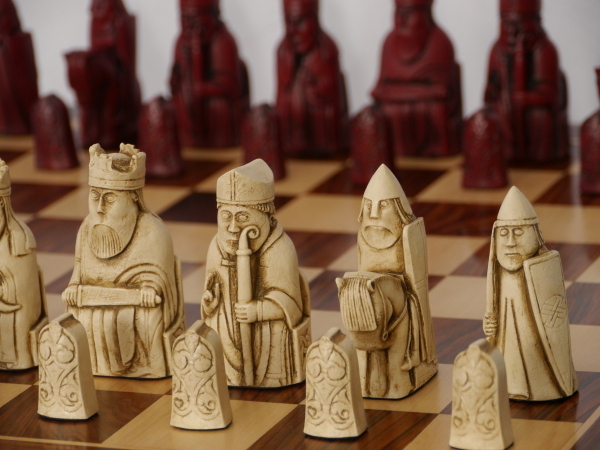
For the familiar understated appearance, the Berkeley Ivory and Brown Isle of Lewis Chess Set is the obvious starting point. Made in England from crushed marble, the pieces are highly detailed from laser scans of the originals. Its king stands 3.5 inches high, with a 1.75-inch base and a weight of 110g.
There is also a heavier Ivory and Brown version. The king remains 3.5 inches high but weighs 145g, giving the pieces a noticeably more substantial feel. If you like the traditional colours but enjoy heavier chessmen, this is probably the version to compare with the standard set.
Ivory and Red Has a Historical Connection
The red alternative isn’t merely decorative invention. Traces of dark red colouring were found on some pieces from the original Lewis hoard, making red an intriguing choice for anyone interested in the history as well as the appearance.
The Ivory and Red Berkeley Lewis set has the same 3.5-inch, 110g king dimensions as the standard brown version. There is also a heavier Ivory and Red version for buyers who prefer the stronger colour contrast together with a weightier feel.
And Then There’s the Metal Version
For something dramatically different, the Berkeley Metal Isle of Lewis Chess Set recreates the familiar characters in steel and copper finishes. The king is still 3.5 inches high, but now weighs 205g. That’s nearly twice the weight of the standard crushed-marble king.
Clearly this isn’t attempting to imitate the material of the medieval originals. Instead, it takes their extraordinary shapes and turns them into a very substantial contemporary chess set. For somebody who loves heavy pieces, this is the Lewis set with the most physical presence.
The Deluxe Aged Set Takes a Different Approach
The ChessBaron Deluxe Isle of Lewis Chess Pieces are aimed more towards the buyer who enjoys the historic character of the originals. Rather than presenting the pieces with a clean modern finish, the crushed-marble set has an intentionally aged appearance.
There is another appealing detail: the set includes alternative rook pieces. The Lewis hoard is famous for its berserker warriors biting their shields, and this version allows you to use those wonderfully eccentric characters or conventional rook pieces according to preference.
Which One Should You Choose?
If you simply want a handsome, recognisable Lewis set, start with the standard ivory and brown version. Choose red if you prefer stronger contrast and like its historical connection. Move to one of the heavier versions if the feel of substantial pieces matters particularly to you.
The metal set is the obvious outlier – and exactly the right choice for somebody wanting maximum weight and a more contemporary interpretation. For a history enthusiast, the Deluxe aged version arguably has the most character, particularly with its alternative berserker rooks.
There isn’t a single correct Isle of Lewis set to buy. The good news is that the essential ingredient survives every interpretation: those unmistakable medieval faces. Eight centuries on, they still look as though they’ve just been told their opponent has found mate in three.