


Why might I buy a set of Metal Chess Pieces rather than Wood? - ChessBaron Chess Sets
Why Might I Buy a Set of Metal Chess Pieces Rather Than Wood?
Wood owns much of chess tradition, but metal pieces offer weight, distinctive finishes and a very different physical experience at the board.
There is a good reason wooden chess pieces dominate the market. Wood feels warm, it carves beautifully and materials such as boxwood, ebony and rosewood have become inseparable from the traditional Staunton set. If you close your eyes and picture a fine chess set, there’s a fair chance you’ve just imagined one made from wood.
But metal offers something quite different. It isn’t necessarily better, and it certainly isn’t a substitute for wood. The appeal lies in weight, feel and appearance. For some players, those differences are enough to make metal the more interesting choice.
The First Difference Is in Your Hand
Pick up a substantial metal king and you immediately understand part of the attraction. Wooden pieces can be weighted, sometimes heavily, but metal has natural density. Moving a solid piece across the board and setting it down has a deliberate quality that is difficult to reproduce with a lighter material.
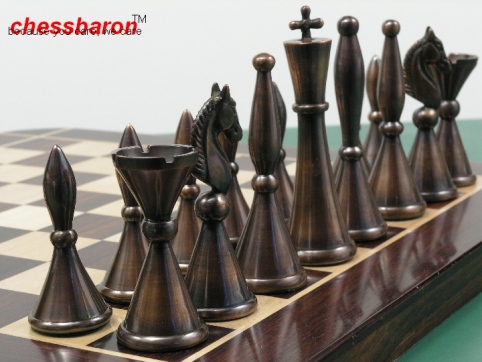
The Sebastian Heavy Steel and Copper Chess Set demonstrates this rather well. Its contemporary pieces combine steel and copper, with the dark side given a pewter finish. The king stands 4.25 inches high, has a 1.3-inch base and weighs 114g. It feels substantial without having the broad footprint that often accompanies a large wooden king.
Metal Can Look Completely Different
Wood naturally lends itself to turned and carved forms. Metal gives the designer another vocabulary. Smooth surfaces, sharp contrasts and metallic finishes can produce pieces that feel contemporary rather than traditional, particularly when paired with a restrained board.
That makes metal particularly interesting when the chess set will live permanently in a sitting room, study or office. A steel, copper or brass set can work almost as a decorative object when nobody is playing. Visitors may even pick up a piece before asking whether you actually play. This is usually the point at which modesty about one’s rating becomes useful.
You Don’t Have to Abandon Staunton
Choosing metal does not require choosing an abstract or futuristic design. Traditional Staunton shapes translate surprisingly well into brass, allowing you to retain the familiar visual language of tournament chess while changing almost everything about how the pieces feel.
The King John Very Heavy Brass Staunton Chess Set takes precisely that approach. Its king is just over 4 inches tall with a 1.6-inch base, and the pieces are triple weighted. The two armies have clearly differentiated finishes, while the detailed knights retain the character expected of a more elaborate Staunton set. Extra queens are also included for pawn promotion.
Metal Ages Differently From Wood
A good wooden set develops character through changes in colour and the natural appearance of its grain. Brass develops character in another way. Exposure to air gradually changes its surface appearance, producing an aged colouring that some owners actively prefer to the brighter look of new pieces.
That is worth considering before buying. Someone who wants every piece to retain an untouched showroom appearance may prefer another material. Someone who enjoys objects acquiring a little history of their own may find the ageing process part of the attraction.
There Are Reasons to Stay With Wood
Metal isn’t automatically the luxury choice. Fine wooden chessmen offer natural variation, warmth and centuries of tradition. They can also provide extraordinarily detailed carving, particularly in the knights. Anyone wanting the classic club or tournament aesthetic will probably continue to gravitate towards wood.
There is also the board to consider. Metal pieces are commonly sold separately from the board, and their weight and finish deserve a suitable playing surface. The Sebastian, for example, is recommended for squares of around 1.5 to 1.75 inches. Matching the base diameter to the board is more useful than looking at king height alone.
So Why Choose Metal?
Choose metal because you enjoy substance. Choose it because you want something visually different from the traditional wooden set, or because the physical sensation of moving a heavy piece adds to the pleasure of a game. A metal set can be contemporary like the Sebastian or recognisably traditional like the King John.
Wood remains the natural home of traditional chess, and rightly so. But if you’ve only ever played with wooden pieces, try picking up a genuinely heavy metal king. You may discover that the argument for metal weighs rather more than you expected.